On Sunday, February 1st at exactly 5:09 p.m., the Full Snow Moon rose over
Sedona—or so Google promised. A friend and I spread a blue Mexican
blanket midway up Bell Rock amid packed parking chaos, hunting a spot in
the sightseer swarm. As a longtime local hiker, I rarely bother with
its admittedly intriguing shape; crowds and highway roar usually deter me. That
traffic droned on through our entire vigil.
Before setting out, I’d done my reading: February’s full moon was called the Snow Moon, a name born from deep winters and frozen fields. No deep winter was happening on Bell Rock that night, where prior to sunset temps hovered right around 70, although, the temps did drop into a brisk crispness as the night progressed.
Astrologically, this full moon faced off with the Sun in Aquarius, balancing Leo’s fierce individual flame with the collective heartbeat of humanity. A cosmic reminder, they say, that our individual sparks matter most when they join the whole. Standing on Bell Rock, I tried to believe that—listening to the rush of cars, beneath a moon that rose, slow and luminous I pondered the astrological implications of the Snow Moon.
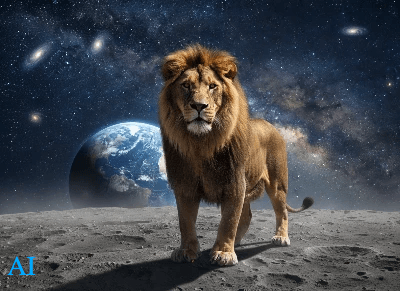
Authenticity sounds good—most of the time.( I like the idea of light, but what if authenticity is dark? What if there is no light to shine? Has this astrologer read the news?)
Release self-doubt and stagnant energy. (I’m drowning in self-doubt.)
Embrace creativity and playfulness. (Some of my favorite things—but how do you play when you’re paralyzed by the aforementioned self-doubt?)
Reconnect with courage to pursue our soul’s purpose. (Courage, I call upon you—let’s reconnect! It’s been a while.)
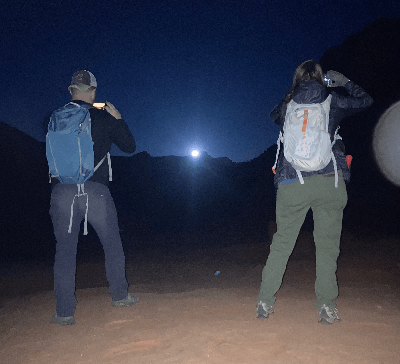
The moon was slow to appear, and no impatient sighing would hurry it along.
It lagged, cresting at 6:45 over eastern rocks. Hikers headed to the parking lot, leaving
our "spaceship" quiet save road noise—no chanting yogis, just a few fellow moon watchers including Alisha and Guy from St. Petersburg.
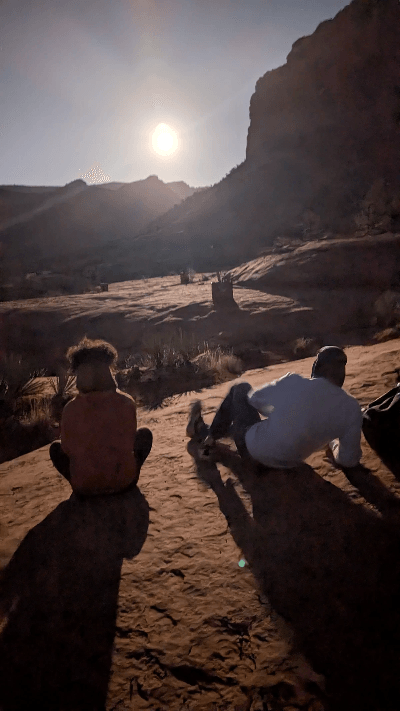
“I’m a moon worshipper, so every full moon is my new moon cycle,” Alisha
told me. “That’s how I like to spend my time—setting new intentions,
focusing on new goals, and just trying to ground myself, trying to help
myself feel more loved in the next cycle. In the last 48 hours I set my
intentions of acceptance and optimism. The goal is to sit with this
energy.
“I was told about the vortexes, to be here on the full moon, on the first
of the month, in such a magical area. I’m open to whatever energy I
receive. It feels welcoming, peaceful, whole. I feel very grounded right
now.
Guy added, “It’s gorgeous out here. It makes me feel small, but in a good way—like a
part of nature, because I don’t think we appreciate it enough.”
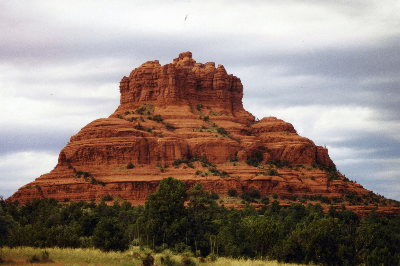
Do you know Bell Rocks ancient history?
Bell Rock formed as part of the Permian Schnebly Hill Formation around 270-275 million years ago, when ancient coastal dunes of windblown sandstone accumulated in a vast desert environment near a receding sea. The distinctive red hue comes from iron oxide that oxidized and stained the layers during deposition, with thinner gray limestone bands marking brief marine incursions that flattened the dunes.
Over millions of years, tectonic uplift from the Mogollon Highlands tilted the layers, while faulting (like the Oak Creek and Verde faults) and volcanic activity south of Sedona added basalt flows and weakened rocks via groundwater. Erosion from wind, rain, and ancient rivers then carved the bell-like butte from the horizontally bedded Supai Group sediments, exposing its spires about 15-6 million years ago.
Rising 500 feet, Bell Rock sits as a resistant remnant amid softer surrounding rock, capped by lighter Coconino Sandstone from later inland dunes, with its shape refined by ongoing weathering into the iconic form visible today.
There was a collective gasp from the few of us left on the rock.A long trail of brilliant lights arced overhead: Elon Musk's Starlink satellites, dozens strong, streaking silently brighter than
stars. We weren't expecting it; everyone whipped out phones, heads
craned in awe. No vortex buzz—just modern tech stealing the cosmic show
over 270-million-year-old red rock.
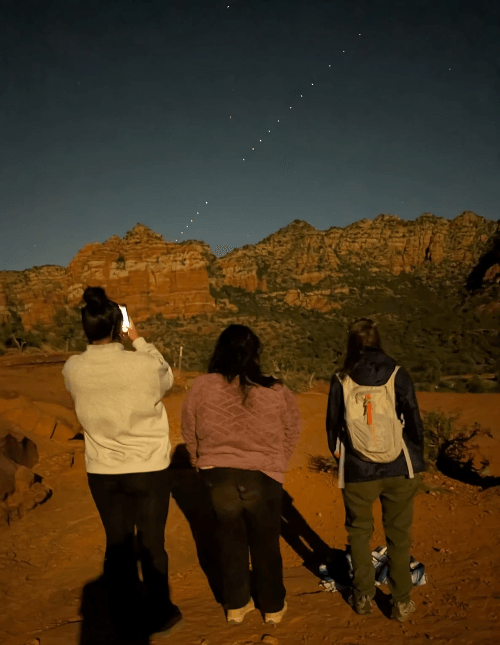
I find solace in nature,and thought this full moon adventure would spark a fun
story—maybe I miss out, cozy in bed, 99.9% of full moons. Instead,
humanity's latest conquest lit up the once-uncharted vastness above.
Starlink's swarm—over 6,000 satellites now and climbing—promises global
internet to the ends of Earth, but from Bell Rock's ancient perch, it
looked like our restless fingers clawing into the final frontier. Once
the Milky Way ruled these skies; now engineered light trains claim them,
satellites outnumbering visible stars on clear nights. We gasped not
just at the sight, but at how fast man is rewriting the heavens—vortex
energy below, orbital empire above.. Bell Rock endures, eroding inches per millennium, but the night sky? That's changing faster than we can look up.