Like many Sedona locals, the sight of a huge plume of smoke north of town stopped me in my tracks Friday around 5:30 p.m. I used to live in Oak Creek Canyon, and I know how quickly it can catch fire — and how dangerous the only two entrances and exits can be.
Like most locals, I spent the next few days alternatively scanning the skiies and monitoring the news and waiting for updates. The Pocket Fire has done something else as well: it has brought a divided Sedona onto the same page. I think we can all agree we do not want a fire to burn our town down.
When I went up to the Sedona Airport terminal at 9 a.m. today to meet Dick Fleishman, the Pocket Fires information officer and media liason. I was running one minute late. He called me, and I knew I’d better step up my citizen journalism game. These guys are professionals, and if I was going to be part of it, I had to do my part too.
So here I’ll share what I learned.
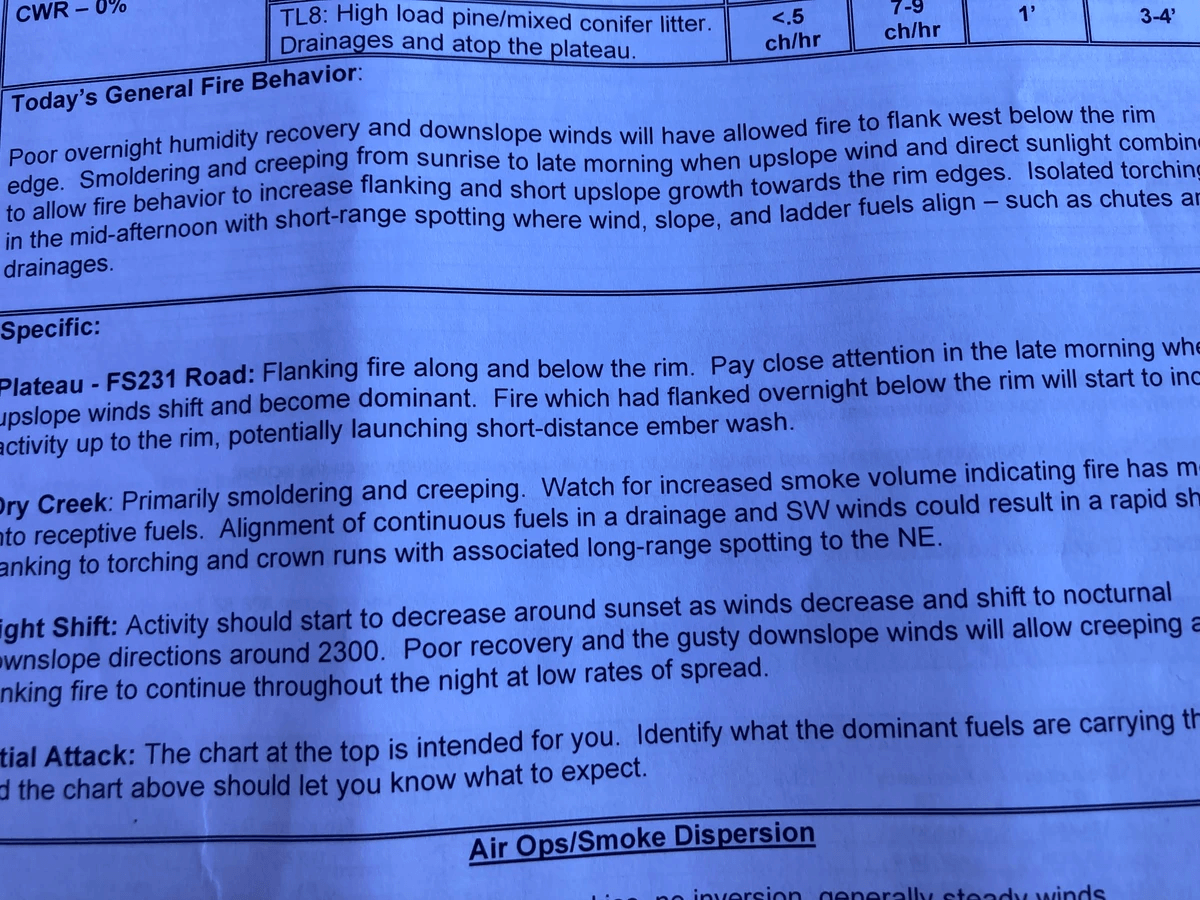
Dick was holding a multi-sheet daily update he had received at the 6 a.m. briefing. He started by showing the large number of personnel involved, along with their many departments and responsibilities.

“These are our marching orders for the day. We have one of these every day, and we do one for the night shift as well.”
It outlines the conditions of from the various boundries of the fire ,the general outlook and the daily objective.
The list of personnel was long,over 400 people in various positions working the fire.A few roles stood out to me.
A fire behavior analyst looks at vegetation, slopes, terrain and weather, then models where the fire is likely to go based on multiple scenarios.
There was also a dedicated meteorologist. The team has forecasts specific to the area, and there are firefighters on the ground taking basic weather measurements for wind, temperature and humidity. That information fine-tunes what they call a spot weather forecast.
The meteorologist is also watching for thunderstorms in the area. Cells can move in quickly, and thunderstorms can create strong down drafts. When that happens over a fire, wind speeds can increase dramatically, which can speed up fire spread.
The communications specialist is key. In someplaces they may even set up a repeater so we can get coverage throughout the whole fire.
Dick also explained in the photo above what the Fire Triangle is.It consists of three elements that make up a fire,heat,oxygen and fuel. Take any one away and the fire will go out.
"We try to take the fuel componants away," he described.
He them delved into how the Pocket Fire is not like a normal fire.
"Normally you go to the place the fire started and you start building line around the sides. We put two hot shot crews in there yesterday",he told me. "There is actually no safe way to get up the sides. It's too steep and too rocky.So they are figuring out our next move."
He told me that in some fires, like the Pocket Fire they break it up into branches."Even though its a small fire, the area it could potentially affect is quite large."
This fire has three branches. There is one on the Rim,one in Oak Creek Canyon and one down here in Sedona.

He told me that one of the most important suppression techniques is
building fire lines.Most of the time, it works, but sometimes a
backfire can spark and start a new fire. That is a job for the hotshot
crews, with some members building the lines and others holding them.
He reminisced about the Slide Fire in 2014 and said it sent a spark three
miles from one side of the creek to the other. So the goal now is to
minimize any chance of spot fires.

"Our objective is to keep this fire out of
Oak Creek Canyon. There are many homes there, but it is also the
watershed. The watershed is key. It has the highest water-quality
standards of any stream in the state. It supports recreation and the
community, but it also supplies water for Phoenix."
Then I asked the question everyone wants answered: how long will it take
until the fire is out? I was both surprised and appreciative of his
candor.
“It won’t be until we get significant rain,” he told me.
The fight against the Pocket Fire is far from over, but the dedication of the crews on the ground and in the air is impossible to miss.
For Sedona, the hope now is simple: keep the fire out of Oak Creek Canyon and wait for the rain that will finally help bring it under control.
Rain dance, anyone?