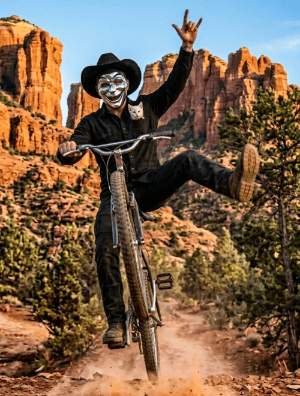
As I awaited my next interview victim (I mean subject), I mulled over Simon's lessons. New to journalism, I longed to approach it like he did Sedona's wildest trails: with daring, confidence, and my own style. Just maybe, one day under perfect conditions, I would fly.
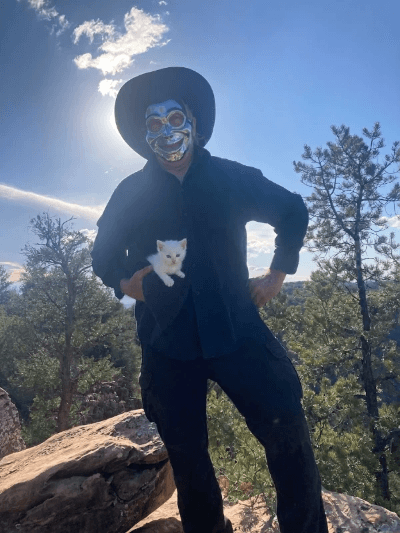
I heard a vehicle pull into my driveway and stepped out to greet the trail builder—we’ll call him Incognito. His attention wasn’t on me, though. He was cradling a white kitten barely two pounds, eyes still shut, while juggling tiny water and food dishes. “I couldn’t resist,” he said “Saw his photo online and had to have him.” He snuggled the mite he called French Fry against his chest as we walked to an outdoor table beneath a grandmother juniper.
Incognito leaned back with a gravelly laugh, ready to spill his multi‑decade saga as one of Sedona’s most prolific—and illegal—trail builders. French Fry was settled on a soft Southwestern blanket on his lap.
I’d known him for years as a friendly acquaintance. During the pandemic, he once showed me a secret trail that fed my endless appetite for Sedona’s hidden paths
“When I first moved to Sedona,” Incognito began, his green eyes pinning me as his story poured out like pent‑up water from a broken dam, “I was introduced to several people who were building trails here. Within a week, I was out working on a new trail with a fairly prolific trail builder. It was probably eight months after that—after I’d explored enough and found an area with good trail potential that no one else was working on—that I started my first one.”
I listened with interest as he described his epiphany on trail building and how it changed his life.
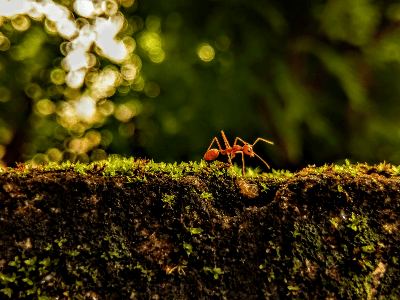
“One day I was in my yard and I saw these huge ants that had made a big ant hill. I noticed there was this half-inch-wide single-track trail coming out from the anthill going all different directions.''
He paused, letting the aha moment land as French Fry patted him with a tiny soft white paw.
"And at that time I realized that all kinds of different creatures, not just humans, build trails. And I developed the philosophy that the creation and use of single-track trail is one of the most natural and harmonious ways in which any creature, including humans, can interact with their environment."
Incognito continued, "I had worked on some trails elsewhere before moving to Sedona, and there was controversy—some articles in mountain bike magazines debating unofficial vs. official trail construction." His take: the Forest Service was remiss in providing the public the trails they wanted and needed.
"Clear back in the '90s," he went on, "when all this debate came into being, the places where I was working on trails had cattle trails. There were Bureau of Land Management cattle leases ranchers paid 20 bucks or 100 bucks a head to graze herds on the land. Those cattle followed the same routes back and forth, weaving a whole network of trails across the mesas."
All animals make trails, he realized and once he started looking, he saw the evidence everywhere.
"Lo and behold," Incognito said, his voice dropping to that gravelly storyteller's cadence, "I'd look under some brushy area and there'd be a little trail going under—like maybe a fox or a rabbit. Or you know, like here, in Sedona there are javelina trails.
He went on to discuss a local's favorite mountain biking trail. “Hog Heaven got its name because much of that trail was javelina trails," Incognito went on, "little 10- to 50-foot sections of javelina trail with bushwhacky sections built to connect them."
French Fry let out a soft meow from under the blanket as Incognito's green eyes lit up.
"There's a ton of criteria I take into account when designing and building a trail," Incognito said. "First, there's got to be a purpose—like going from here to there. Second, consistent technical level. Third—and most amateur builders fail here—is water management. It's huge. Straight up/down a hill compacts into ruts that channel water, cutting deeper erosion you'll never fix. Instead, traverse across with a 3-to-5-degree outslope—water from above hits the trail and crosses right over, gone quick."
"Typically at 45 degrees or less—90 straight across down to 45—so it doesn't run further than the trail's width," he added. "For washes, find rock slabs. Dirt bottoms erode knee-deep in one monsoon— a nice trail becomes a sudden drop. Slabs last centuries, no further erosion."
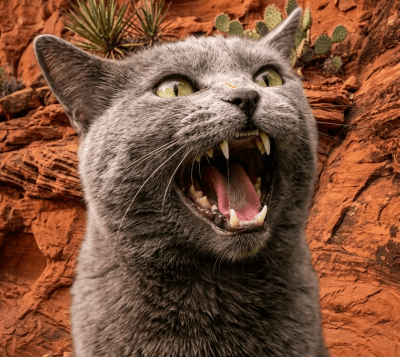
We were interrupted by an angry screech. My gray cat, Fig—queen of the household—watched from the closed patio, incensed by French Fry's unauthorized presence and her own lack of an invite to the interview. I jumped up to placate the feline royalty with a snack, my strategy for most things in life.
"What kind of tools do you need?" I asked. "What's involved? Were you wearing camo out there, or... paint the picture for me."
"Well, depends who you are," Incognito said, French Fry purring beneath his giant scarred hands. "The Forest Service, International Mountain Biking Association, legit trail companies they run miniature walk-behind bulldozers for 'machine-cut' trails like Blowout Wash above Cottonwood Airport. No soul, in my opinion. Soul ripped from the land. But they're wide—three feet or more—smooth, dug-in deep."
"Is that what you were using?" I asked.
"No. For me, I don't use tools."
Beep-beep-beep-beep—for the first time, my bullshit meter screamed. C'mon, I thought, no way you build a trail without tools. It's like showing up to frame a house bare-handed. But I'm a professional journalist (wanna-be, anyway), so I swallowed my disbelief and mildly inquired, "So how do you do that?"
"I'll walk back and forth over a route to figure it out," he said, "maybe kick a rock out of the way or lift one. Kind of kick a little ledge into the dirt. Push a pretty good-sized thing into a hillside just by walking back and forth and kicking it every day for a couple weeks."
"Mm hmm," I said.
His eyes glinted like he'd cracked Sedona's red rock code. "Any branch up to about two inches snaps easy by hand—especially quick. Slow bend? They flex, crack, splinter, stay hung. But snap fast—clean break! If a rock's too big to dig or shove by hand, I route around. Same with vegetation: tree in the way? New line. Branches need a saw? Reroute. I mostly dodge stacking retaining walls on the downhill edge."
I remained doubtful until two others confirmed Incognito's story. Simon called him a minimalist—an approach he saw as more environmentally sound for trail building. Another builder, no minimalist himself, used the same word for Incognito. It's a small world of renegade trail builders; they all know each other's styles and quirks.
"What would you say to those who claim illegal trail builders damage the environment?" I'm channeling Barbara Walters now, although I have no fancy suit, stylist or lighting guy. It's just me, my crying cat and my holey birkenstocks.
Incognito's eyes narrowed. "Think about a trail's footprint. Hand-built singletrack maxes at two feet wide. Times 5,280 feet per mile? That's 10,560 square feet—one acre covers 43,560, so over four miles per acre. Now Highway 89A through Sedona: travel lanes, turn lanes, bike paths, sidewalks—100 feet wide. Every 435 linear feet, an acre's gone. Acres paved for highways and parking lots, and they gripe about a skinny trail? I can't take 'em seriously."
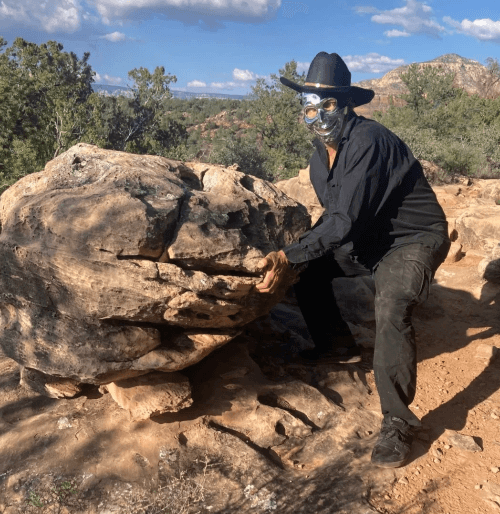
The talk shifted to the art of the trail. "To me, a trail is a three-dimensional interactive sculpture which is only complete during times of use."
"So it's only complete when someone's on it?" I asked
"Yeah, because there's a performance art component to the trail and any trail designer who's worth a damn has to consider the performance art aspect of the trail," he said. "Like when you're creating a trail, you have to think of what technical level, what skill level you're building that for. Are you building a beginner trail, an intermediate trail, an advanced intermediate trail, an expert trail, something that's just crazy top-expert like the thing that Lars just put in, Hardline.
"Yeah, I'm kind of curious," he added, pondering. "Like, I'm wondering, 'Can I ride that?'"
I've been hearing about Hardline too since starting this series. Lars Romig built it with Forest Service approval and resources—the hardest sanctioned trail in the U.S., they say. I haven't hiked it yet but plan to soon. I will definitely NOT be mountain biking it, but it would be fun to see Incognito and Simon tackle it
Incognito turned pensive. It felt like all that couldn't be shared for so many years—decades of outlaw secrecy blowing in like an unexpected monsoon—was flowing out of him.
"When I'm out riding, I am very spiritually in tune with the land," he said. "I mean, I am that way anyhow sitting here in your backyard looking at this gorgeous big old tree.
"Hiking, even more so in some ways," he continued. "We're going to see more of it, see how it all connects and interacts, and we're away from all these manmade houses and fences and walls and chimneys and driveways, and hopefully away from the noise of the automotive world.
"But on the bike, to me there's just a whole 'nother layer to that spiritual nature of the connection with the land," he added. "I'm still getting the same visuals I get when I'm hiking, but I'm feeling that flow of the Earth's surface, all the ripples and rolling hills. To me it's the most incredible connection I know with the land.'''
Incognito leaned forward, his voice softening. "So, as far as building trail, there is a very similar spiritual connection to the land because I'm thinking, as I'm building it, what it's going to be like to ride it. There's already that aspect of riding it coming through in the imagination before it even exists."
I nodded, picturing him out there sussing out a trail line—eyes tracing phantom lines across red rock and juniper before a tire ever touches dirt.
"As I'm out exploring, looking for the best route," he continued, "I'm thinking, okay, if I go across that rock over there, how does it go? If I take the turn around that tree or inside that tree, how does that feel—both with the flow and with the visual aspect of it? How good of a look do you get at the tree? What do you see off in the distance?
"There's very much the same spiritual aspect there, that connection to the land," Incognito said. "But there's actually an additional one when you're building it, and that's just creativity.
"The act of creating anything, to me, is quite sacred," he continued. "Whether you're painting a picture, building a house, or as a kid stacking blocks—you're building, you're creating. That's such a primal need for people.
"That aspect is already kind of gone by the time you're riding it," he added, "but it's in full force when you're out there exploring and figuring out the route and actually doing the physical construction, watching the transformation as you go.'"
I related deeply—what he described mirrored my own creative process. For me too, creating brought that spiritual spark of play, joy, and connection.
"One thing that I noticed years ago is that on a mountain bike, on a properly built trail, you really feel the flow of the terrain. You get that in a way that hiking or even trail running can't really give you, because of the speed involved as well as type of motion. Walking is so much up and down, whereas if you're riding a trail at speed you just get such a feel for the flow of the surface of the land.
"It's almost like a dance," Incognito said. "It's like your bike is your dance partner and you're leading the dance, but instead of music, it's the trail. The trail sets the rhythm. Or whether there's any syncopation to it or whatever. Like that is to a mountain bike ride what music is to regular dancing."